• Start
  • TULIP Studie
  • PANF nieuw
  • PANF Studie
  • Teamleden
  • Contacten
  • Wetenschappelijke artikelen
  • Home
  • TULIP Study
  • PANF new
  • PANF Study
  • Researchers
  • Contact
  • Scientific Articles
  • Startseite
  • TULIP Studie
  • PANF neu
  • PANF Studie
  • Team
  • Kontakt
  • Wissenschaftliche Artikel
NEUROFEEDBACK
  • Start
  • TULIP Studie
  • PANF nieuw
  • PANF Studie
  • Teamleden
  • Contacten
  • Wetenschappelijke artikelen
  • Home
  • TULIP Study
  • PANF new
  • PANF Study
  • Researchers
  • Contact
  • Scientific Articles
  • Startseite
  • TULIP Studie
  • PANF neu
  • PANF Studie
  • Team
  • Kontakt
  • Wissenschaftliche Artikel
Neurofeedback Research

Department of Clinical Neuropsychology - University of Groningen


Have you ever wondered how our brains work?

It turns out that our brains generate different types of brainwaves for all the things we do, from thinking and learning to relaxing and sleeping. Some of these brainwaves play a crucial role in how we function and think. A specific type of brainwaves that is important for the aforementioned executive functions is the theta brainwave at frontal-midline electrodes (frontal-midline theta).​

What is neurofeedback

Neurofeedback offers an insight into how your brain works. But that's not all. With neurofeedback, we can even learn to regulate your brain activity ourselves. This method uses a cap fitted with electrodes (an electroencephalogram or EEG) to measure brain activity.
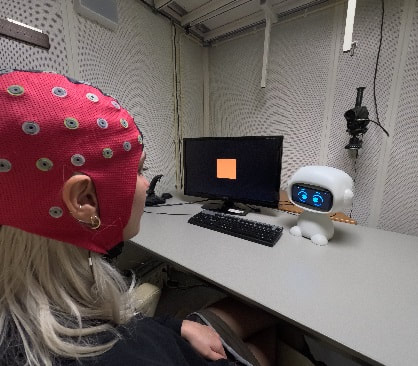
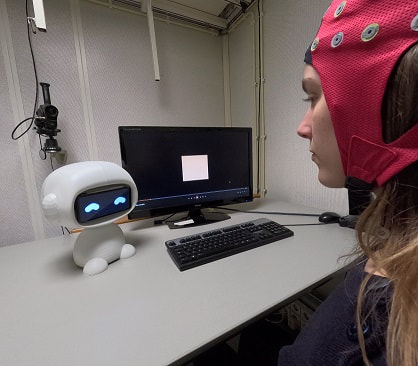
During neurofeedback, you sit in front of a computer screen and can try out various mental strategies to steer your brain activity in the desired direction.  The EEG electrodes record your brain waves in real time and the neurofeedback protocol focuses on analysing specific aspects of this activity. The screen displays this information, often using visual cues such as the changing colour intensity of a square to reflect the strength of your brain activity.
Neurofeedback essentially enhances your senses and allows you to understand and regulate your brain's activity through the feedback provided by the software. The aim is for you to learn to control your brain activity to improve cognitive function or in some cases reduce clinical symptoms. For more details, please see the video below.

Our research

At the University of Groningen, we are conducting scientific research on the effect of neurofeedback training on executive functions. The term 'executive functions' is a collective term for various controlling and directing functions of the brain that are crucial in our daily lives. Currently, we are specifically investigating the acceptability of neurofeedback companions for a neurofeedback training in other studies we assess the integration of psychedelics to enhance the training effects.
more info

Our Current Projects 

TULIP
As part of the TULIP project, we are developing a neurofeedback companion that provides support during frontal-midline neurofeedback. We are currently testing the acceptance of this companion and, in a future study in early 2024, whether the neurofeedback companion actually leads to significantly improved results.
More Info

Latest News 

PANF news
Our preprint on our feasibility study on psilocybin-assisted neurofeedback has been published. For more information, click the button below.
More info
Development of the prototype of our neurofeedback companion: the TULIP project
During the second half of 2023, we have been busy developping our neurofeedback companion. This project is a cooperation between the University of Groningen and a research institute in Bordeaux (INCIA lab), France.
Foto
Foto

Picture
Proudly powered by Weebly
  • Start
  • TULIP Studie
  • PANF nieuw
  • PANF Studie
  • Teamleden
  • Contacten
  • Wetenschappelijke artikelen
  • Home
  • TULIP Study
  • PANF new
  • PANF Study
  • Researchers
  • Contact
  • Scientific Articles
  • Startseite
  • TULIP Studie
  • PANF neu
  • PANF Studie
  • Team
  • Kontakt
  • Wissenschaftliche Artikel